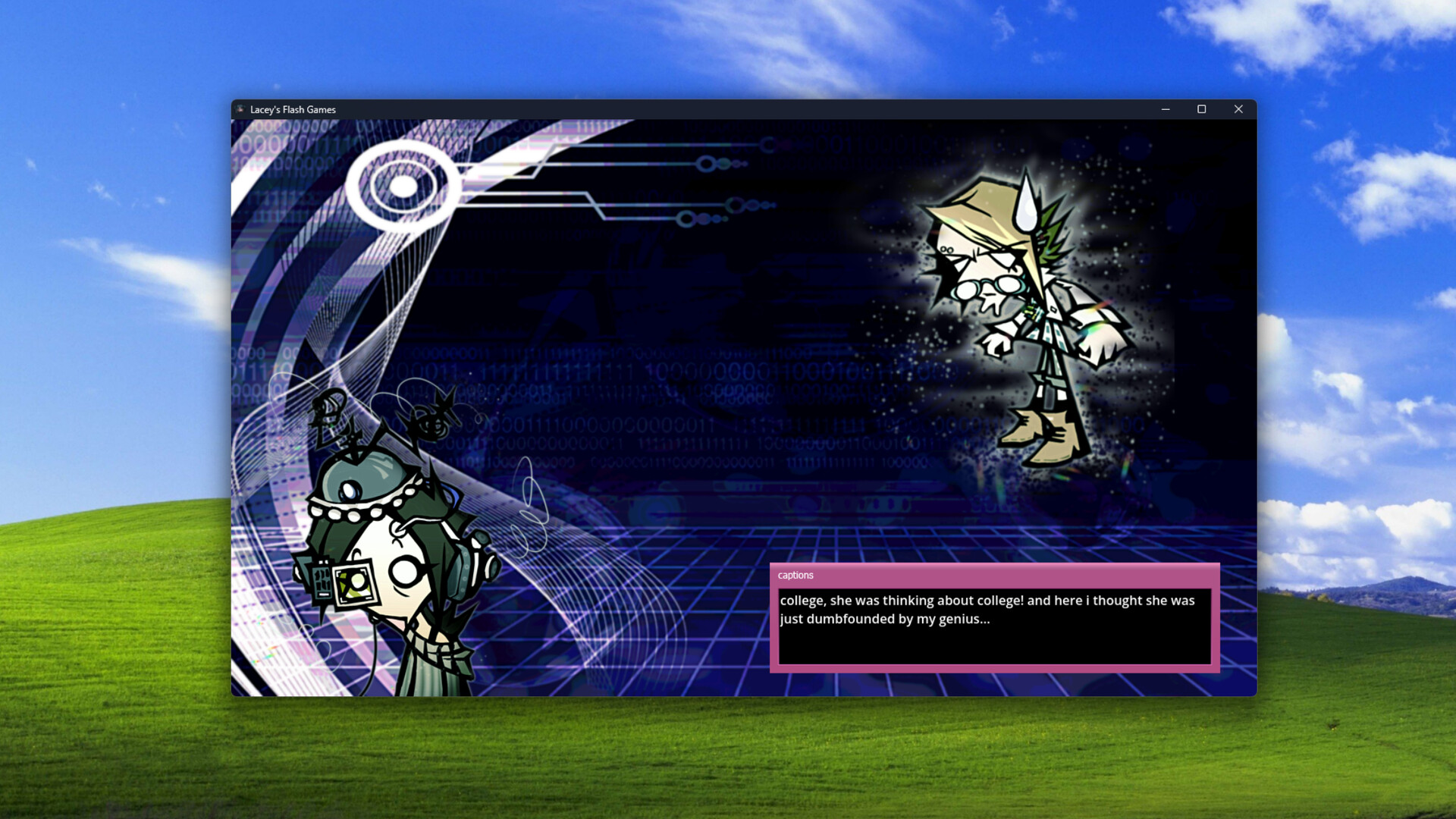
The Lacey's Flash Games demo ending follows the Love Meter sequence and sets up the larger investigation into missing creator Rocio Yani. Player reports describe credits and a continuation, so this is the demo's finale rather than a verified resolution of the forthcoming full game. The clearest explanation is to separate the events that end the playable introduction from the audience theories about what the wider mystery means.
Which ending are you trying to understand?
The same series name can lead you to original horror episodes, the official playable demo, and fan adaptations with their own outcomes. An ending from one of those contexts does not automatically explain a different release, even when it features Lacey or reuses a familiar activity. Begin by identifying whether you have just finished the official demo or watched an episode before looking for a definitive conclusion to the whole story.
This page concerns the documented official-demo finale and the premise supplied by its developers. It does not treat a fan-game liberation ending as the conclusion of the official narrative or turn a theory video into a source for an unreleased final scene. The all-endings guide handles the practical completion checkpoints if your question is about reaching the sequence rather than interpreting its position in the story.
What happens at the demo's stopping point
Players in the demo discussion describe reaching the Love Meter sequence, seeing the credits, and encountering a continuation of the larger mystery. The progression pair associated with this finale is Lacey / Uncle, following the earlier Wardrobe and altered Petshop route. Those reports establish the demo's documented endpoint without establishing that its last sequence provides the final answer to Rocio's disappearance.
That boundary explains why finishing the available route can leave the story feeling unresolved. The experience you have completed is an introduction to the official adaptation, while the full collection was still forthcoming at the October 25, 2026 research cutoff. A continuation at the end of the demo is therefore consistent with the version's scope rather than evidence that an unlisted final puzzle must be solved before the entire story makes sense.
Keep Charlie's investigation at the center
The developer's description names Charlie, also known as Charchar887, as the person who discovers the virtual Lacey website and its disturbing games. The investigation concerns the missing website creator Rocio Yani, making her whereabouts part of the official premise rather than a side question introduced only by fan interpretation. The demo's ending should be placed inside that investigative setup before assigning a broader explanation to individual images or name reactions.
Rocio belongs to the fictional developer layer of the story, while Lacey is the character within its activities. This layered presentation means that a statement about who made the in-universe games is not the same as a real-world production credit. The Rocio character guide maps Charlie, Grace, Rocio, and Lacey without collapsing them into a claim about the biography of ghosttundra.
Distinguish events from explanations
An observed sequence, a character's testimony, and a viewer's explanation provide different kinds of information. A character can guide the player or deny involvement without that statement automatically becoming an authorial confirmation of everything it implies. When reading an ending discussion, ask whether it describes what happens, quotes what someone in the fiction says, or proposes an interpretation that goes beyond those events.
This distinction is particularly useful when the disturbing imagery is linked to Rocio's experiences in a commentary. Such a connection can be an audience reading without being a verified account of the full game's final explanation. The supplied material does not establish a single supernatural mechanism or a definitive true ending, so this article keeps the concrete demo endpoint and official investigation premise separate from those unresolved interpretive claims.
| Detail | How to read it |
|---|---|
| Love Meter finale | Documented endpoint of the demo route |
| Credits and continuation | A transition beyond the playable introduction |
| Missing Rocio Yani | Central subject of the official investigation premise |
| Character testimony | A statement within the fiction |
| Theory video | An audience interpretation, not a final-game solution |
Place the original episodes in their own context
The original Petshop episode is a creator-published narrative artifact whose description frames an interview with a website cofounder followed by game footage. It helps establish the series' layered presentation of people discussing games that exist within the fiction. That is useful background for the adaptation, but the episode is not interchangeable with the installed demo's input sequence or its progression into Love Meter.
The same distinction applies to the original Wardrobe and Diner material discussed by commentators. An analysis of those episodes can predate the playable demo, so it cannot independently establish the final scene of a later full release. Use the original videos to understand what the series presented at that stage, while keeping a later adaptation's actual events attached to the release in which players encounter them.
Understand why theory videos differ
The research includes independent commentary from Gearisko and The Game Theorists. Those videos offer interpretations of the original series, and the Game Theory upload predates the official demo. Their existence establishes that the story invites analysis, not that a commentary has the authority to settle the forthcoming game's final answer or verify an unseen scene.
A compelling reading can still be useful when it clearly distinguishes its reasoning from a confirmed event. The problem comes when an interpretation is repeated as though it were a developer statement, or when a fictional character's experiences are turned into assertions about a real creator. This guide avoids that shortcut and directs practical questions about the finale trigger to the Love Meter combinations page.
Where the larger story is intended to go
The official development Q&A says the full game is intended to conclude the series' story. That statement describes the developers' intention for the larger release, while the available demo supplies an introduction and continuation point. It should not be expanded into a fabricated account of who survives, where Rocio is found, or which explanation the final game will endorse.
For now, read the demo finale as the end of the documented playable introduction and the beginning of the next part of Charlie's investigation. If you want to review the path leading there, the demo walkthrough connects Wardrobe, Petshop, and Love Meter in order. If you want the character background instead, use the Rocio guide and keep the official premise separate from theories until a source actually supplies the missing resolution.