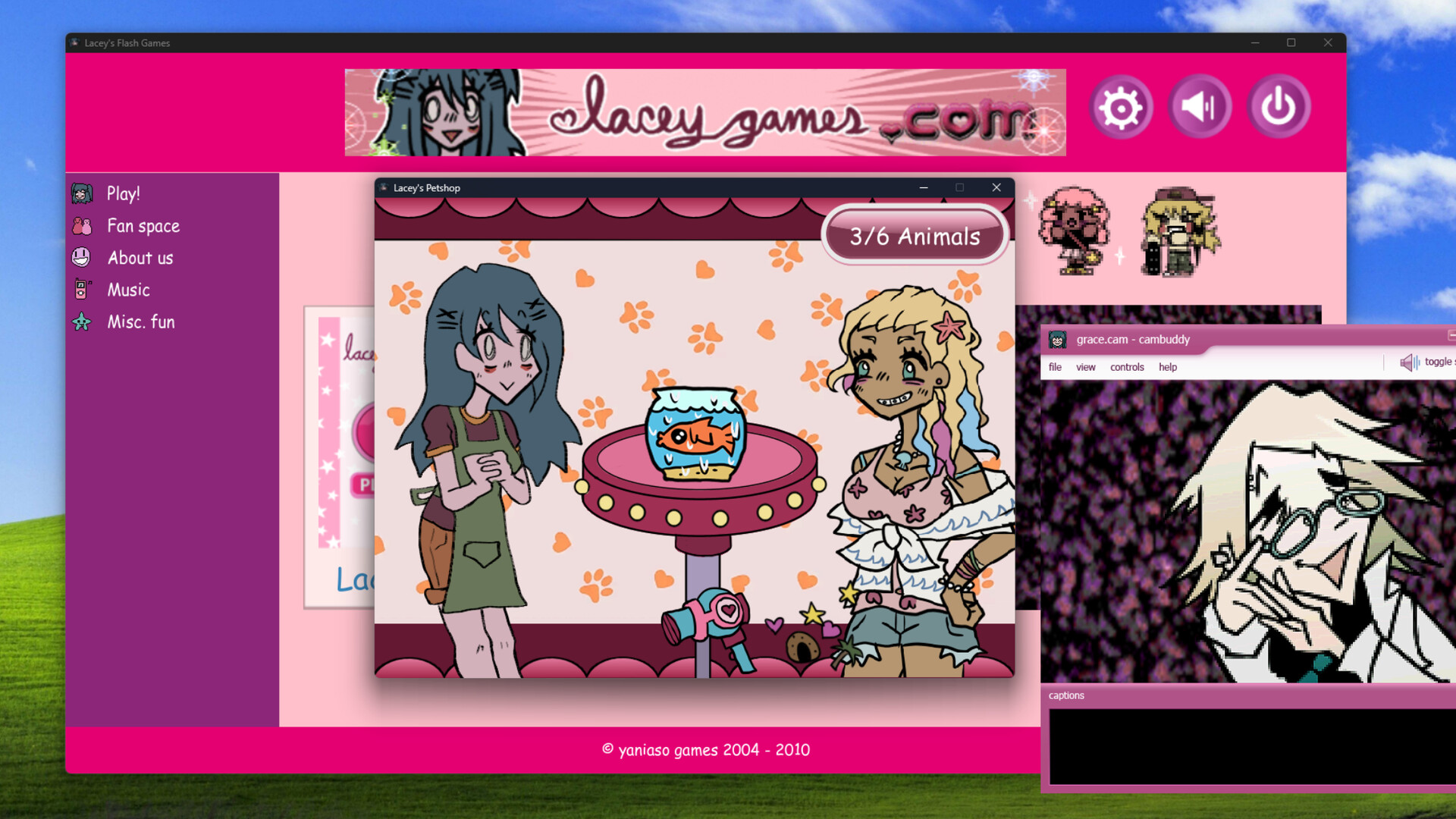
For a Lacey's Flash Games Diner walkthrough, first identify the version: the original Diner is a horror episode presented as footage of a fictional cooking game. Its sequence moves through cooking tasks, failed timed orders, escalating imagery, a closure notice, and a bad-ending card. The supplied research does not establish a tested final-release Diner route; the documented official demo instead covers Wardrobe, Petshop, and Love Meter.
Start with the original episode's identity
Ghosttundra uploaded the original Diner episode on November 1, 2022, making it the second episode identified in the supplied series references. Its title describes a disturbing secret ending in a 2007 Flash game, but that found-game framing is part of the fiction. It should not be read as proof that the upload itself appeared in 2007 or that a standalone recovered cooking game from that year has been verified as an official download.
The episode is an original creator-published narrative artifact, not a recording of every possible input in a released final adaptation. This difference matters when a search for a walkthrough leads you to a scene that you cannot reproduce in the available demo. The right first question is which version the source describes, rather than which hidden ingredient or control you must be missing from a different release.
Follow the cooking-game facade
The episode presents a cooking activity whose visible tasks include dragging ingredients and responding to orders. That ordinary game-like structure provides the setting for the horror sequence rather than establishing a complete interactive ruleset that a separate player can necessarily reproduce. You can use the tasks to follow what the episode depicts without turning them into a new recipe list or a claim about the full collection's final controls.
A useful episode walkthrough explains the sequence in the order the story presents it. The apparent restaurant tasks come first, making the later failures and changed imagery intelligible against a familiar activity. This is an account of a fictional game's presentation, so the guide should not invent branching inputs merely because the footage uses an interface associated with playable cooking games.
Understand the failed timed orders
The supplied episode summaries describe failed orders and a timeout sequence as part of the escalation. Those events help move the scene away from its ordinary cooking facade and toward the disturbing material that follows. They do not, on their own, establish a verified strategy for avoiding every failure, a precise timer value, or a different winning branch in the forthcoming playable version.
If you are watching the original episode, follow those failures as events in an edited narrative. A scene that appears to show a mistake can have a storytelling role without offering viewers a documented alternative input sequence. This keeps an episode guide accurate to the material instead of replacing its disturbing progression with a fabricated set of perfect-order instructions or an unsupported claim that a secret ingredient changes the ending.
Read the escalation and ending in context
After the cooking facade and failed orders, the supplied summaries describe increasingly disturbing imagery. The sequence also includes a closure notice and ends with a bad-ending card, giving the original episode a visible conclusion within its found-game presentation. These are the supported landmarks for understanding the video, rather than a numbered list of independently unlockable final-game outcomes.
A bad-ending label does not by itself verify a separate playable good ending in another release. To establish such a route, a guide would need evidence from that identified interactive build rather than an inference from the label alone. The ending explanation applies the same distinction to the demo's continuation, separating the endpoint players report from larger theories about how the complete story resolves.
| Episode landmark | What it explains |
|---|---|
| Cooking and ingredient tasks | The ordinary activity presented at the start |
| Failed timed orders | A documented stage of the episode's progression |
| Escalating imagery | The movement from familiar tasks into horror |
| Closure notice | A later narrative landmark |
| Bad-ending card | The visible conclusion described by the episode summaries |
Keep Diner outside the documented demo route
The available official-demo guide covers Wardrobe, Petshop, and Love Meter. Its route does not establish a Diner sequence that can be unlocked by completing those activities in a different order or entering another name pair. If you downloaded the official demo expecting the cooking episode, the activity mismatch is a version question rather than proof that you have failed to find a hidden menu.
The demo overview explains what the supplied material documents as playable in that introduction. The full walkthrough then follows the corroborated route through its actual sections. Keeping Diner's original episode separate from those instructions prevents a video about the wider series from becoming a promise about a segment the available demo route does not cover.
Understand the official game's development context
The developer's Q&A discusses placeholder customer artwork for Diner, placing the activity within the official project's development context. That is relevant evidence that the name is connected with the collection's work rather than only with unrelated fan creations. It does not provide the final puzzle solution, an exact sequence of customer orders, or a verified branch count for a released build.
At the October 25, 2026 research cutoff, the full Steam collection was still forthcoming. The release-date guide covers its planned October 27 date, while the minigame catalog distinguishes documented demo activities from wider series and preview names. Those sources help place Diner in the project without pretending that promotional context supplies a tested walkthrough before the relevant build has been checked.
Match any playable adaptation to its own guide
A fan-made Diner advertised in a video needs its own author and version identity before its controls can be compared with the official project. The familiar activity name or character does not establish identical mechanics, developer authorization, or a complete reproduction of the original episode. Treat a fan adaptation as its own implementation rather than using its interface to fill gaps in the official collection's documented instructions.
For a story-focused visit, the creator's original Diner episode is the appropriate source for the cooking facade, failed orders, and ending card. For an official-demo gameplay question, use the matching three-activity walkthrough and keep Diner separate from that route. This version-aware answer gives you an accurate account of the available material without inventing a task order, ingredient recipe, or final-release ending trigger that the supplied research does not support.